
Our Footie Heroes - Ferenc Puskas
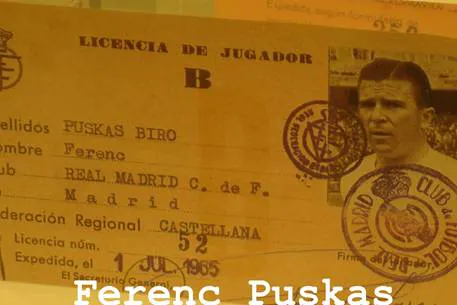
Born on April 2nd, 1927, in Budapest, Hungary,
Ferenc Purczeld Biró
came to lead the greatest national football team ever assembled:
the Hungarian National Team of the early 1950s.
Ferenc began his career on a local club called Kispest
which was converted into an army sports club named Honved.
The club became all powerful because it was able
to recruit the best players in the country through conscription
(everyone on the team had a rank and Ferenc became a Major).
Ferenc did not look the part of a naturally gifted footballer:
he was short, fat, couldn’t head the ball and could only use one foot.
But what a left foot he had…he could launch rockets from anywhere on the pitch.
With a forward line composed of Ferenc, Sandor Kocsis and Nandor Hidegkuti;
Gyula Grosics in goal; and a right half in Jozsef Bozsik,
the Mighty Magyars were unstoppable, winning 32 consecutive games.
And they didn’t just win games…they crushed the competition.
At Wemblay Stadium in 1953, an English player commented:
“Look at that little fat chap. We’ll murder this lot.”
Hungary won 6-3, inflicting the first Foreign defeat on England at home.
In 1954 in Budapest, a return match saw Hungary win 7-1.
With this record, the country went into the 1954 World Cup as the clear favorites.
Unfortunately, they lost to Germany in the Final 3-2 with an injured Ferenc Puskas on the field.
In 1956, Honved were on the road in Europe when the revolution erupted at home.
Ferenc and a few teammates decided to remain in Europe.
FIFA punished them with a two year ban.
Now at 31 years of age and still short and overweight,
no team was willing to give Ferenc a chance…except Real Madrid.
Combining with Alfredo di Stefano, he led Los Blancos to many a glory,
highlighted by victory in the 1960 European Cup Final (where Ferenc scored 4 goals).
The Spanish fans revered the goal scorer, nicknaming him Cañoncito (little cannon).
He finally retired in 1966, competing in 180 La Liga games and scoring 156 goals.
With all his success on the pitch, his greatest moment may have come in 1993,
when the Hungarian government pardoned him
and he returned to coach the national team in the build-up to the 1994 World Cup.